Maryland system Interoperable departments Field article Wildlife profile

Sightings & safety guide

Panther / Cougar Sightings

Western Maryland has a long tradition of panther stories, especially from steep creek hollows, dark ridges, and remote roads in Garrett and Allegany mountain country.

This page does not claim that a wild cougar population is established in Maryland. It gives readers a careful way to handle reports, sounds, tracks, and safety without dismissing what someone may have genuinely heard or seen.

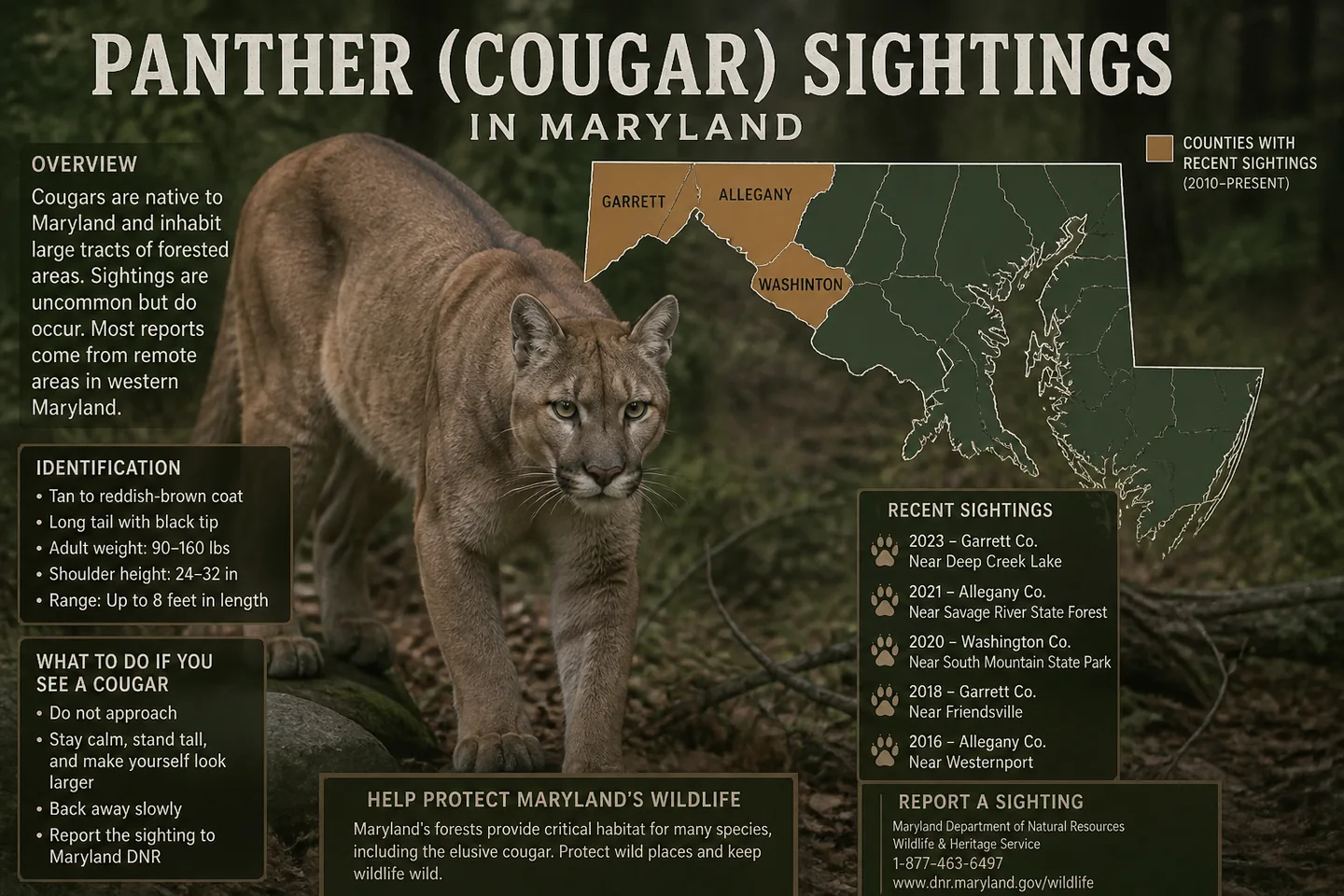
Sightings & safety guidePanther and cougar sightings field guide illustration for Maryland
Large-cat sighting pages should reduce rumor and teach careful evidence, distance, and official reporting boundaries.

Professional field lens

Read Panther & Cougar Sightings Guide as part of a larger Maryland system.

A strong wildlife profile should not end at identification. Use this page to connect the animal to habitat structure, seasonal windows, field signs, public-land choices, public education, and low-impact observation.

At first glance

Start with habitat before the animal

Ask what water, cover, food, edge, light, and human pressure are doing. The same species can read differently in a marsh, ravine, stream bottom, cove, older woods, or suburban edge.

Browse wildlife by habitat

Timing window

Treat season as part of the identification

Breeding, migration, leaf-off sightlines, high water, low water, dawn, dusk, heat, cold, and food availability can change what is visible and what should be left undisturbed.

Browse wildlife by season

Glossary links

Use field terms as working links

When a profile mentions field sign, edge cover, refuge pools, older woods, tidal rivers, coves, or stream bottoms, follow the glossary to the habitat and place pages that explain the term.

Open the glossary

Low-impact method

Watch without pressuring the animal

Keep distance, avoid repeated approaches, respect nests and dens, stay on durable surfaces where appropriate, and verify official access rules before sensitive outings.

Read field ethics
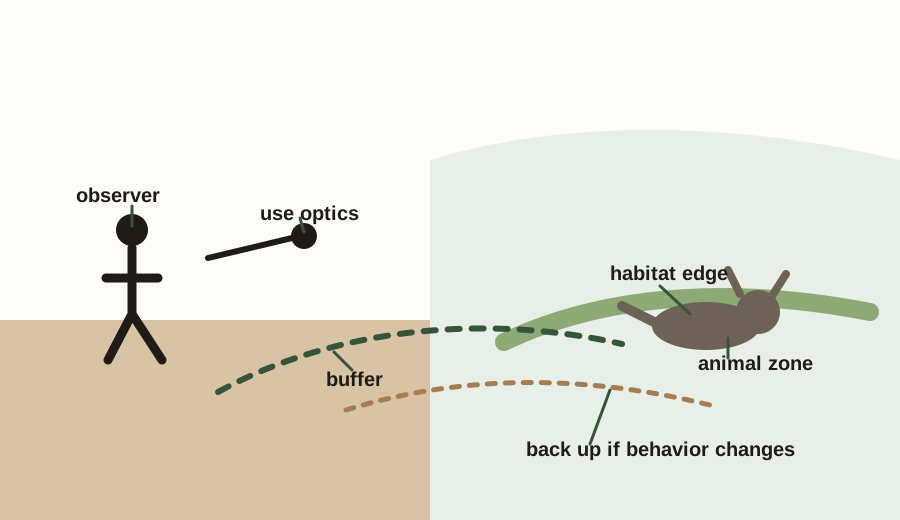
Wildlife observation distance diagram showing observer, buffer, habitat, and animal behavior zone.

Observation card

Watch without crowding

Read the animal through habitat, movement, sound, and behavior. Distance is part of the observation, not a barrier to it.

Habitat first

Notice food, cover, water, edge, perch, den, scrape, or travel route before focusing on the animal alone.

Behavior sets distance

Back up if the animal stops feeding, watches you, changes path, vocalizes, flushes, or hides.

Use optics

Binoculars, quiet pauses, and side-on positioning create better observations than approach.

Field check

  • Stay on durable surfaces.
  • Do not feed or call wildlife.
  • Use zoom instead of approach.
  • Leave before behavior changes.

Quick field read

A report may be sincere even when the final identification is uncertain. A cry in the dark, a flash of a long body, and large tracks in creek mud can feel convincing. The responsible question is not whether the witness should be believed or mocked. The responsible question is what evidence remains after common explanations are tested.

Use this first

  • If the sound could be a person in distress, call emergency services rather than walking toward it alone.
  • If the sound may be wildlife, keep distance, gather people and pets, and leave the area calmly.
  • Photograph tracks with a ruler, boot, or common object beside the print for scale.
  • Do not follow a scream, creek-bank trail, carcass, or fresh tracks into cover at night.
  • Report clear evidence to the appropriate wildlife authority, especially if there is a public-safety concern.

The “woman crying” or “baby screaming” sound

People sometimes describe a panther call as a woman crying, a baby screaming, or a piercing scream coming from a creek hollow. Cougars can make a penetrating scream in places where cougars are established, especially during breeding behavior, so the comparison is not invented. The problem in Maryland is that the sound alone does not confirm a cougar.

Several real animals can make humanlike or alarming night sounds. Bobcats can yowl, caterwaul, and scream. Red and gray foxes can bark, scream, and call at night. Coyotes can produce high yips, howls, and distressed-sounding group calls. Barred owls, domestic cats, livestock, dogs, and young animals can also sound startling in ravines, along water, or under windy conditions.

Creeks can make the sound feel closer, larger, and more directional than it really is. Water, rock, laurel, hemlock, and steep banks can reflect a call, so a single animal may seem to be moving or calling from several places at once.

When tracks are found near the sound

Tracks matter, but creek mud is one of the easiest places to over-read evidence. Soft mud can enlarge a print. Sliding paws can stretch a track. Partial dog, coyote, bear, or bobcat prints can look cleaner or rounder than they really are. A track found after a scream also may belong to a different animal that used the same corridor earlier.

Evidence that helps

  • Several clear tracks in a line, not one isolated print.
  • Photos from directly above, plus a scale object.
  • Stride pattern, trail width, and direction of travel.
  • Whether claw marks appear in the print.
  • Tail, body shape, shoulder height, and gait if the animal was seen.
  • Time, weather, location type, and whether dogs, livestock, or people were nearby.

What it may be in western Maryland

In Garrett and Allegany mountain country, the most practical comparison set includes bobcat, coyote, red fox, gray fox, black bear, domestic dog, domestic or feral cat, and occasionally an escaped or illegally held exotic animal. That list is less dramatic than “panther,” but it fits the evidence pattern behind many real reports.

Bobcat

The best large-cat comparison in Maryland. Bobcats are real, secretive, and capable of fierce vocalizations, but they are much smaller than a cougar and have a short tail.

Coyote or dog

Common explanations for nighttime sound and large tracks. Dogs and coyotes often leave claw marks, travel creek corridors, and can sound larger when several animals call at once.

Red or gray fox

A small animal can make a large, unsettling sound. Fox screams and barks are a frequent source of humanlike night-call reports.

Black bear

Bears are established in western Maryland and can be dangerous if surprised, protecting young, feeding, or near human food. Bear tracks in mud can be misread when partial.

Actual large cat

A cougar cannot be ruled in by sound alone. It would require strong evidence such as clear photos, multiple tracks, trail-camera footage, DNA, a carcass pattern, or official confirmation.

Human distress

Never ignore the possibility that a scream is a person. Do not enter a risky area alone; call for help and give the best location details available.

Why approach is still dangerous

Even if the sound is not a cougar, approaching it can still be dangerous. A person may be in trouble. A dog or coyote may be agitated. A bear may be feeding or moving with cubs. A bobcat or fox may be cornered. A private property, road, creek bank, cliff, or low-visibility hollow can create more risk than the animal itself.

Use distance, light, documentation, and reporting. Do not try to prove the sighting in the moment. The best evidence is usually collected safely: photographs of tracks, notes on the sound, direction, timing, and location, and any trail-camera or security-camera files that can be reviewed later.

Safety rule

If the animal might be large enough to injure you, or if the sound might be a person, do not investigate alone. Back out, make a report, and document from a safe place.

Read more by topic

Maryland status

Maryland references list cougar, mountain lion, panther, and puma under Puma concolor and classify the animal as regionally extinct with no wild occurrences in Maryland. That status does not mean every witness is lying. It means the site should not describe the species as established without official evidence.

How to evaluate a report

Separate the report into parts: sound, sighting, tracks, location, timing, and any photo or video evidence. A strong report usually has more than one line of evidence. A weak report may still be worth noting, but it should not become a confirmed animal page.

How to describe the sound

Write down whether the call was a single scream, repeated cry, yip sequence, owl-like call, growl, bark, or caterwaul. Note the time, weather, direction, duration, and whether dogs, coyotes, owls, livestock, or people were also audible.

How to document tracks

Photograph the track before stepping near it. Include a scale object, then photograph the trackway from several angles. Do not rely on one enlarged print in creek mud. The pattern of several tracks is usually more useful than a single dramatic mark.

Keep reading

Evidence-first sighting review

Separate the story from the evidence before naming the animal.

Unusual-cat pages need discipline: size estimates, distance, lighting, tracks, photos, known species, and official reporting all matter more than rumor momentum.

Best use

Review a claim calmly

Use the page when a sighting report needs context before it becomes a confident identification.

Elite move

Anchor every claim to evidence

Photos, track scale, behavior, location, and comparison species are stronger than memory alone.

Common mistake

Letting surprise become certainty

Low light, distance, tail view, and motion can make common animals look extraordinary.

Next step

Use official reporting and comparison pages

Document what you can, avoid online escalation, and route credible evidence to appropriate agencies.

Field cues to carry forward

  • Record date, time, location, distance, and light.
  • Photograph tracks with scale if safe.
  • Compare bobcat, coyote, fox, dog, and house cat possibilities.
  • Avoid baiting, chasing, or trespassing for confirmation.

Official source check: sensitive species

Observe sensitive species with extra distance and restraint.

Sensitive-species pages are intended for identification, habitat context, and low-disturbance observation. Do not use them as handling, collecting, disturbance, nest approach, relocation, or take guidance.

Source-check refresh: May 7, 2026. Verify current rules, closures, permits, seasons, health guidance, and access conditions with the official agency before acting.

Seasonal review

Field conditions change the meaning of a guide page.

Season, weather, breeding windows, young wildlife, high water, heat, hunting seasons, closures, and protected-species timing can change what a reader should do next.

Seasonal review refresh: May 7, 2026. Always verify current rules, closures, permits, seasons, and protected-species instructions with Maryland DNR, the county health department, or the official land manager before acting.

Spring

Breeding windows, vernal pools, nesting birds, young wildlife, high water, mud season, and bat colony formation can make ordinary field behavior too intrusive.

Summer

Heat, storms, ticks, snakes, beach protections, nesting colonies, flightless young, and bat maternity timing should push readers toward shade, distance, and official timing checks.

Autumn

Migration, mast, rut movement, hunting seasons, bear food pressure, leaf-off visibility, and falling temperatures change both wildlife behavior and public-land use.

Winter

Ice, hypothermia, road closures, waterfowl concentration, denning, hibernation, and low daylight require conservative trip planning and no-disturbance wildlife observation.

Wildlife guide trail

Keep moving from species ID into habitat, season, place, and field terms.

Use this path when a wildlife profile should connect to the larger Maryland Wilderness field-guide system instead of ending after identification.

Term paths

Use glossary terms to move between wildlife, habitat, and service pages.

Blue dotted glossary terms open quick definitions. These hubs collect the vocabulary that helps readers find the right department faster.

Wildlife glossary Animal signs, behavior, health, and structure-use terms Tracks, scat, home range, den sites, rabies-vector language, and wildlife-conflict terms. Flora & fauna glossary Ecology, habitat, food-web, and biodiversity terms Use this path for environmental science vocabulary that connects species to habitat. Site search Search a term, animal, place, service, or activity Use search when the glossary popup is not enough and a page-level route is needed.

Interoperable guide system

Continue through Wildlife

Use the previous/next links for this department, then jump sideways into the related Maryland Wilderness departments that help explain the same outing, animal, place, or season.